
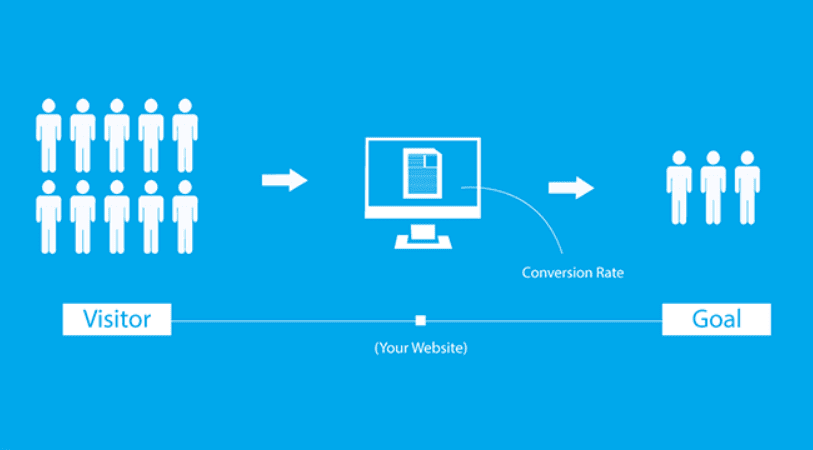
Having an online presence is crucial for every business. However, it’s not just enough to just have a website— you need to be able to turn your online visitors into clients. The process of converting visitors to clients can be a challenging one, but with the right strategies, it can become a seamless process.
In this article, we’ll discuss 6 effective ways to turn your online visitors into clients. These tips are based on data-driven insights on consumer behavior and have been proven to work for businesses of all sizes. Whether you’re a small business or a large corporation, you’ll find valuable insights that will help you increase your conversions.
Your online conversion rate represents the number of visitors to your website who convert into customers. A significant portion of our analysis and program implementation for a client is based on increasing this number. So let’s get started!
1. Fully optimize your website.
Your website is often your potential customers first impression of who you are, what you do, and why they should choose you over the competition. It should be designed with some elements of Search Engine Optimization (SEO) in place to help your website rank for the top keywords in your industry.
It’s very important to consider every part of your website right down to the page URLs and back end title, alt, and meta description tags. Think of each page as its own “mini-site”. You want every page to be optimized and converting for you otherwise why include it at all?
There are ways you can measure a page’s performance and then make adjustments based on this data. If you would like to know more about this process please feel free to contact us here.
2. Evaluate your links.
Once you have a good site up and running, analyze where the links on your site are taking potential customers. When visitors land on your site, you have a limited amount of time to capture their attention and convince them to take action. Many business owners take everyone to their homepage. This is a mistake, especially if you sell products. By sending visitors to a homepage instead of a specific page relevant to their interests, you are essentially asking them to navigate through your site on their own to find what they are looking for.
It’s important to put yourself in the mindset of your target client or customer. Let’s say someone is looking for a specific type of wine glass for an upcoming dinner party. They find one of your ads on Google and click it. By clicking on it they expect to be taken to more details about the wine glass and a shopping cart. If you take them to your home page instead, they can become frustrated and leave your site to visit your competition.
In today’s competitive online marketplace people want things quickly and easily. The easier you make it for your target audience, the higher the chance you’ll get that conversion.
3. Content for SEO.
Your website content is also known as “on-site” SEO. As you add new information to your site, are you including relevant keywords that will attract the right prospect to your site?
When you’re doing this, be sure not to use a method called “keyword stuffing”. What this means is that you don’t use the keyword or phrase more than 2 times per hundred word article. After the first hundred words you can add the keywords one more time for each additional one hundred words.
Once again, it’s important to put yourself in the position of your client or future customer. Are you providing them with enough information to make a decision without having to go look for it within your site?
If your website happens to sell products, a visitor to your site should be able to find the category of product they are looking for quickly. You also want to include detailed but engaging product information and prices. By doing so, your conversion rates have a greater chance of increasing. If the information you provide isn’t attractive enough or worse yet – absent, you’ll receive next to no conversions from your site.
If you need more guidance on creating SEO-rich content for your website, we recommend checking out this article on SEO Content Strategy.
4. Make your contact information clear on each and every page.
Put a clear call to action on every landing page, above the fold. (“Above the fold” is what a visitor can see on their screen before scrolling down.) You want to ensure that it doesn’t disrupt the flow of your website. You can make it obvious without it being an eyesore.
An exit intent pop up is a great way to capture your audience before they leave your site. If you provide them with a free offer such as a download or gift or alternatively a discount on their next purchase, you’re almost always going to generate a lead from that call to action.
When you don’t ask a client or customer to take the next step, your conversion rate will almost always be much lower than it should.
At this point, we get some resistance from clients who don’t feel comfortable “asking for the sale” up front. We get it, it’s like asking someone to marry you on a first date. But if you’re trying to gain business from someone who you don’t know or might never meet, it’s important to be clear on exactly what you want that client or customer to do.
5. Constantly monitor your site’s appearance.
Over time you’re going to want to continue to add widget boxes, images and other elements that will start to “clutter” your website’s appearance. These can also slow down the “load speed” of your site, an important Google metric. At the time every bit that you add on makes sense, but eventually your website will become unappealing with too many distractions which can result in your potential client/customer feeling overwhelmed and simply leaving.
Even the most successful companies, including small local ones, do a complete refresh of their website every two years. This saves them a lot of time and money considering the alternative of rebuilding it (we do this a lot for our current clients).
A great analogy is if you were to visit a grocery store and all of the aisles were mismatched and out of place. You try to find what you want but you can’t, or when you do it’s in a completely different area of the store that makes no sense. After having such experience, would you go back to this store? Or would you shop elsewhere?
If you’re unsure if your website could use a little revamping, check out 5 Signs That It’s Time For A Website Refresh.
6. Incorporate Retargeting Marketing
Retargeting campaigns keep you top of mind to your customers because they act as a reminder about your website, product, and/or service. Once someone visits your site they can then be shown visual or text ads from your company, keeping your brand and offers in front of them so you have a greater chance at conversion. Platforms used to assist in retargeting include Facebook, LinkedIn and Google Ads. (Our 3-Pak program provides the most comprehensive conversion funnels on the market. See if our program is right for you, click here to learn more).
I hope you’ve found this article helpful. Try implementing some of these ideas and start tracking your results. Need help? At Alchemy, we’ve been working with clients across the US for over 18 years. You can contact us at 877-978-2110 or email gordon@thealchemyconsultinggroup.com.